Warming up the engine…
Practice Area
Underride and override collisions, where a smaller vehicle collides with the trailer’s undercarriage, are some of the most catastrophic crashes on the road. We investigate the trailer, its safety equipment, and every company responsible.
Free. Confidential. No obligation.
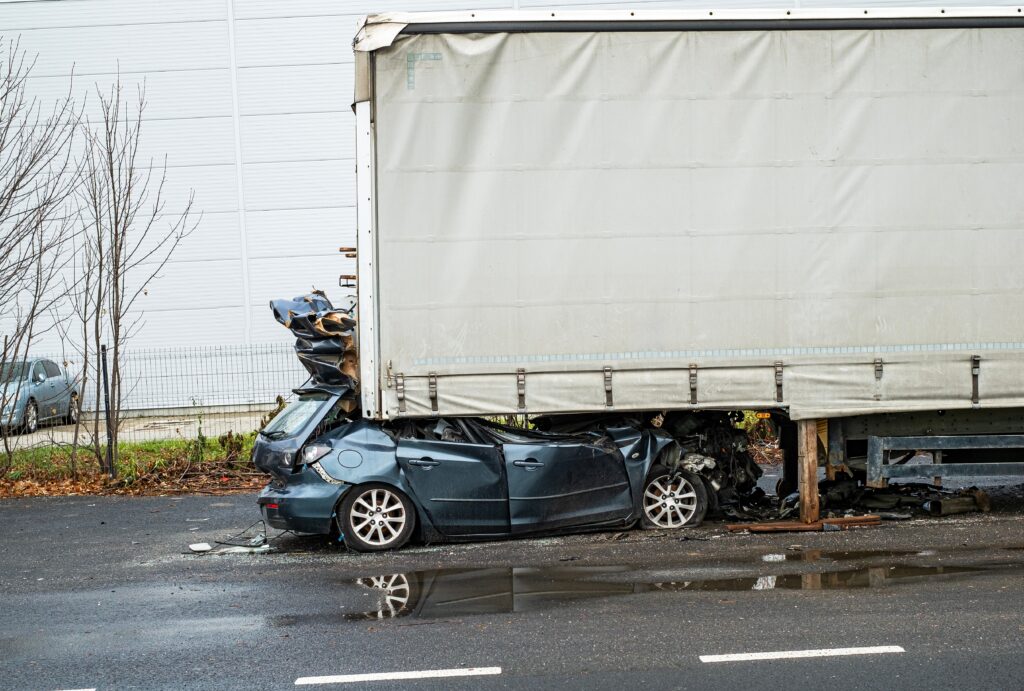
In an underride crash, a car slides beneath the rear or side of a trailer, and the trailer can strike the passenger compartment above the car’s safety features. In an override crash, a truck rides up and over a smaller vehicle, often in a rear-end collision.
Federal rules require rear impact guards on most trailers, with standards for their strength and placement. As of this writing there is no federal requirement for side underride guards. Whether a guard was missing, damaged, or poorly designed can affect who is responsible.
Common Causes
01
Poorly maintained or weak guards can fail on impact.
02
Trailers that stop suddenly or lack working lights and reflective tape are hard to see.
03
Trailers turning across lanes create side-underride hazards.
04
A truck that cannot stop in time can override a smaller vehicle.
05
Tired or distracted drivers react late in traffic and at intersections.
06
Dark trailers across the road are especially hard to see at night.
Who Is Responsible
Liability in a truck accident case can extend well beyond the driver.
Next Steps
01
Call 911 and get checked even if you feel fine. Some injuries, like brain and spinal injuries, show symptoms hours or days later, and medical records connect your injuries to the crash.
02
If it is safe, photograph the vehicles, the scene, the truck’s DOT number, and your injuries. Collect names and phone numbers of witnesses.
03
The trucking company’s insurer may call quickly. Avoid recorded statements and do not sign anything until you have talked with a lawyer.
04
We move to preserve driver logs, electronic data, and dash-cam footage before it is lost, and we handle the insurers so you can focus on your health.
FAQ
Federal regulations require rear impact guards on most trailers. As of this writing, side underride guards are not federally required. The condition and design of any guard can be important evidence.
Every state sets its own deadline. In Georgia and Ohio, for example, you usually have two years from the date of the accident to file a personal injury claim. However, deadlines can change depending on your situation, so talk to an attorney soon to protect your rights.
Many states use comparative negligence rules. In Georgia, for example, you can recover if you are less than 50% at fault. In Ohio, you can recover if your share of fault is not greater than that of the parties you are suing. In both states, any recovery is reduced by your share of fault, which is why insurers often try to blame the victim.
We follow a clear, step-by-step process so you always know where your case stands. Your first conversation is free, and there’s no obligation.
Free. Confidential. No obligation.
Black Trucking Lawyers serves truck accident victims nationwide through office locations across the United States.
Every state sets a deadline to file a personal injury claim, and evidence like black box and ELD data can disappear much sooner. Tell us what happened and we will explain your options.
Free. Confidential. No obligation.